



Enterprise training has moved far beyond uploading presentations and asking employees to complete online courses. Modern organizations need learning environments that connect employee development, operational efficiency, compliance requirements, and measurable business performance.
That’s where Learning Management Systems become a strategic investment rather than another piece of HR software.
An effective enterprise LMS combines scalable technology, intelligent automation, useful analytics, and engaging learning experiences. However, getting these elements to work together requires careful planning. Understanding the architecture, implementation strategy, and optimization methods behind enterprise learning platforms can help organizations build training ecosystems that actually deliver results.
1. Understanding Enterprise Learning Management Systems
An enterprise learning management system is a centralized digital platform designed to manage, deliver, track, and evaluate organizational learning activities.
Unlike smaller training applications, enterprise platforms must accommodate complex company structures, thousands of users, multiple departments, different languages, and strict security requirements.
These systems support various training activities, including employee onboarding, leadership development, technical certification, regulatory compliance, and professional upskilling.
How Enterprise LMS Platforms Differ From Traditional Solutions
Traditional training platforms generally concentrate on course delivery and basic completion tracking. Enterprise environments require significantly greater flexibility.
For example, a multinational company may need to deliver the same cybersecurity course across 15 countries while adjusting language, compliance requirements, reporting permissions, and certification schedules.
A modern LMS must manage those variations without forcing administrators to create entirely seperate training infrastructures.
Enterprise solutions also integrate with existing business systems, allowing training records to connect with employee profiles, job responsibilities, and organizational performance indicators.
Why Learning Infrastructure Matters
Training technology becomes increasingly important as organizations expand.
Without centralized learning infrastructure, companies often struggle with inconsistent materials, duplicated administrative tasks, disconnected employee records, and limited visibility into training effectiveness.
A well-designed platform creates a consistent learning environment while giving individual departments enough flexibility to manage their specific development needs.
The ultimate objective isn’t simply delivering more courses. It’s building organizational capabilities that contribute to measurable business outcomes.
2. Enterprise LMS Architecture and Core Technical Components
The architecture behind an enterprise learning platform determines how efficiently the system processes information, supports integrations, and handles growing user demand.
A strong architecture balances flexibility, performance, security, and long-term maintainability.
Application and Presentation Layers
Most enterprise platforms use a layered architecture that separates the user interface, application logic, data management, and external integrations.
The presentation layer handles interactions between learners, instructors, and administrators.
Employees access learning dashboards, training catalogs, assessments, and certification records through web browsers or mobile applications.
Meanwhile, the application layer manages enrollment rules, course availability, learning pathways, notifications, assessments, and administrative permissions.
Keeping these responsibilities separated helps development teams update individual components without unnecessarily affecting the entire system.
Database and Content Management Infrastructure
Enterprise learning environments generate substantial amounts of information.
User profiles, course metadata, assessment results, training histories, attendance records, and completion certificates require reliable storage.
Relational databases are commonly used for structured transactional records, while object storage can accommodate videos, documents, and other large learning assets.
Content delivery networks can improve access to training materials for geographically distributed employees.
However, architecture decisions should reflect actual workloads rather than assumptions about future growth.
Cloud-Native and Multi-Tenant Deployment Models
Cloud-based LMS architecture offers opportunities for elastic resource allocation, managed infrastructure, and centralized software updates.
Organizations commonly evaluate single-tenant and multi-tenant deployment approaches.
A single-tenant deployment provides dedicated application resources for one organization, potentially simplifying certain isolation requirements.
Multi-tenant infrastructure allows several organizations or business units to share selected resources while maintaining logical boundaries between their data.
According to Microsoft’s Azure Architecture Center, multitenancy introduces important trade-offs involving isolation, performance, cost, reliability, and customization.
For enterprise buyers, the key question is whether the chosen deployment model satisfies security and operational requirements at an acceptable total cost.
Microservices and Modular Architecture
Some enterprise platforms adopt microservices to separate functions such as authentication, course delivery, reporting, notifications, and certification management.
This approach can allow independent development and scaling, but it also introduces additional operational complexity.
A modular monolith may be more practical for organizations with smaller engineering teams or relatively stable workloads.
The best architecture is not necessarily the most complicated one. It’s the structure that remains dependable, manageable, and adaptable as requirements evolve.
3. Building an Effective Enterprise LMS Implementation Strategy
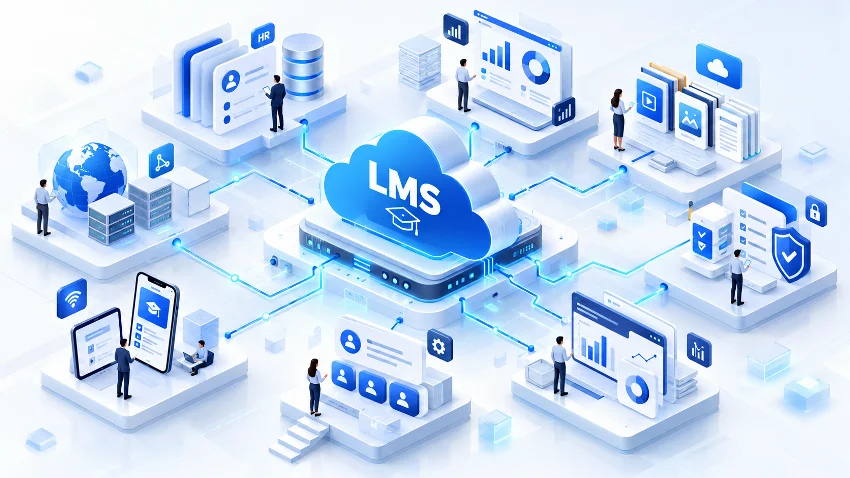
Technology selection is only one part of a successful enterprise learning initiative.
Even a sophisticated platform can underperform when implementation decisions ignore employee behavior, business priorities, and organizational readiness.
Align Learning Goals With Business Objectives
A useful implementation strategy begins by defining what the organization wants to improve.
For a manufacturing company, the priority might be reducing safety incidents. A financial institution may concentrate on regulatory training, while a technology company could focus on engineering certifications.
These objectives should influence platform configuration, learning pathways, assessment design, and reporting requirements.
Instead of measuring success exclusively through completed courses, organizations should examine whether training contributes to actual improvements.
Conduct a Detailed Training Needs Assessment
Before configuring the platform, identify existing skill gaps and learning requirements.
This assessment can combine employee interviews, performance reviews, competency frameworks, department feedback, and historical training data.
Consider an organization with 5,000 employees distributed across sales, operations, engineering, and customer support.
Each department may need different learning formats, certification schedules, and reporting capabilities.
Understanding these differences early prevents unnecessary customization and expensive adjustments after deployment.
Develop a Phased Implementation Roadmap
A phased rollout generally reduces operational uncertainty.
An organization might begin with a pilot involving 200 employees before expanding across several departments.
The pilot should test login procedures, enrollment workflows, content compatibility, accessibility, administrative responsibilities, and reporting accuracy.
Feedback from real users can uncover problems that technical testing alone misses.
Once the core workflows perform reliably, the company can gradually introduce additional learning programs and advanced integrations.
Establish Clear Learning Governance
Enterprise learning governance defines who creates courses, approves content, manages enrollment rules, and maintains employee records.
Without clear ownership, outdated training materials and inconsistent administrative practices can accumulate.
A central learning team might establish organization-wide standards while allowing departmental managers to customize training within agreed boundaries.
This approach maintains consistency without eliminating local flexibility.
4. Integrating Enterprise LMS Platforms With Business Systems
Integration capabilities are among the most important considerations when evaluating enterprise learning technology.
A standalone LMS may deliver courses effectively, but disconnected information limits its strategic value.
HRIS and Human Capital Management Integration
Connecting an LMS to a human resources information system allows employee information to flow between platforms.
When a new employee joins the organization, their department, position, and location can help determine which training programs they should receive.
Similarly, changes in job roles can trigger new learning requirements.
Automated synchronization reduces manual administration while improving the consistency of training assignments.
However, data ownership and synchronization rules must be defined carefully to prevent duplicate records or incorrect enrollments.
API-Based Integration and Interoperability Standards
Application programming interfaces allow learning platforms to communicate with other enterprise applications.
For example, an LMS may exchange information with talent management software, collaboration tools, assessment providers, and business intelligence platforms.
Several learning technology standards support interoperability.
SCORM is widely associated with packaging and tracking conventional e-learning content. xAPI, also known as the Experience API, supports records of learning activities across a broader range of environments.
The xAPI model uses a Learning Record Store, or LRS, to receive and maintain learning activity records.
Meanwhile, Learning Tools Interoperability (LTI) provides standardized connections between learning platforms and external educational tools.
The 1EdTech LTI 1.3 framework introduces a security model that supports more secure tool integration.
Selecting appropriate standards helps organizations protect their content investments and reduce dependence on proprietary integrations.
Connecting Learning Data With Business Intelligence
Learning records become more useful when combined with operational information.
Imagine a customer support department measuring whether advanced communication training influences customer satisfaction scores.
Connecting LMS data with performance dashboards allows analysts to examine possible relationships between training participation and business results.
However, correlation does not automatically establish causation.
Organizations should account for experience levels, workload changes, managerial differences, and other factors before attributing performance improvements directly to training.
5. Security, Compliance, and Data Protection in Enterprise Learning
Enterprise learning platforms frequently contain sensitive employee information, including personal details, performance assessments, qualifications, and professional development histories.
Protecting this information requires more than basic password security.
Identity Management and Access Control
Centralized identity management helps employees access approved learning resources without maintaining unnecessary login credentials.
Single sign-on, commonly implemented through standards such as SAML or OpenID Connect, can simplify authentication.
Multi-factor authentication adds another layer of protection, especially for administrators and users accessing sensitive records.
Role-based access control limits available functions according to responsibilities.
For example, a department manager might view training progress for their team without accessing confidential records belonging to another division.
Applying Zero Trust Security Principles
Zero trust security assumes that access requests should be evaluated continuously rather than automatically trusted because they originate inside a corporate network.
NIST Special Publication 800-207 describes this approach as a framework centered on protecting resources and evaluating access.
In an LMS enviroment, these principles can inform authentication controls, administrative privileges, service-to-service communication, and access monitoring.
They are particularly relevant when employees access training from personal devices, remote offices, or external networks.
Protecting APIs and Learning Records
Integration endpoints create additional security responsibilities.
The OWASP API Security Top 10 identifies risks such as broken object-level authorization, authentication weaknesses, and security misconfigurations.
Organizations should review API permissions, validate incoming information, protect credentials, and maintain appropriate activity logs.
Data retention policies also matter.
Training records should be stored only for justified business or legal purposes, with deletion and access procedures aligned with applicable regulations.
Security design should be reviewed whenever platform functionality or integration requirements change.
6. Optimizing User Experience and Learning Engagement

Technical reliability is essential, but it doesn’t automatically guarantee employee participation.
A learning platform succeeds when employees can find relevant content, understand their development opportunities, and complete training without unnecessary friction.
Personalizing Learning Pathways
Personalized learning experiences help employees focus on material relevant to their responsibilities.
An entry-level analyst might begin with data fundamentals before progressing into advanced reporting and visualization.
An experienced analyst could enter a specialized certification pathway based on demonstrated competencies.
Rules-based recommendations, competency assessments, and carefully governed AI-assisted suggestions can support this personalization.
However, recommendation quality depends heavily on accurate employee information and a well-organized course catalog.
Improving Mobile Learning and Accessibility
Employees increasingly expect training experiences that work across different devices and working conditions.
Responsive interfaces, clear navigation, readable typography, and appropriately compressed media improve usability.
Mobile-friendly content becomes especially important for frontline workers who rarely spend their working day at a desk.
Accessibility should also be part of the design process.
The W3C Web Content Accessibility Guidelines 2.2 provide recommendations addressing issues such as keyboard navigation, visual accessibility, and interaction design.
Practical improvements include accessible course controls, video captions, meaningful image descriptions, and assessment formats that don’t rely exclusively on visual cues.
Using Microlearning Without Sacrificing Depth
Microlearning divides educational material into focused lessons that employees can complete within shorter periods.
It works particularly well for procedural refreshers, product updates, and specific workplace skills.
However, complex subjects such as cybersecurity architecture or advanced financial analysis usually require more comprehensive instruction.
A balanced learning strategy combines short lessons with workshops, simulations, mentoring, and structured assessment.
Gamification can add engagement through progress indicators, achievement badges, and learning milestones.
These features should reinforce meaningful development rather than encourage employees to race through courses simply to collect rewards.
7. Measuring LMS Performance and Continuous Optimization
A platform that delivers training but provides little insight into results leaves considerable value unexplored.
Enterprise learning analytics should support both technical optimization and better business decisions.
Defining Meaningful Learning KPIs
Completion rates remain useful, particularly for mandatory training, but they tell only part of the story.
Organizations should also examine participation trends, assessment performance, certification renewal, skill development, and learning-related operational outcomes.
Consider a company delivering a technical certification program to 1,000 employees.
If 850 complete the program, the completion rate is 85%.
However, if only 600 demonstrate the required skills during a practical assessment, the demonstrated proficiency rate is 60% of the original group.
This distinction shows why completion alone cannot establish training effectiveness.
Evaluating Learning Return on Investment
Learning ROI compares the measurable benefits of training with its associated costs.
A simplified calculation is:
Learning ROI (%) = [(Financial Benefits − Training Costs) / Training Costs] × 100
Suppose an employee training initiative costs $80,000 and generates an estimated $120,000 in attributable operational savings.
The calculated ROI would be 50%.
However, that result is only credible if the organization has reasonable evidence connecting the savings to the program.
Controlled comparisons, pre-training baselines, and transparent assumptions help strengthen financial evaluations.
Organizations should also consider nonfinancial benefits, including risk reduction, improved employee confidence, and better knowledge retention.
Optimizing Infrastructure Performance
Technical performance influences whether users complete their learning activities smoothly.
Important operational measures include application response times, error rates, service availability, video delivery performance, and failed integration requests.
Infrastructure teams can use monitoring dashboards to identify bottlenecks before they affect large numbers of learners.
Caching frequently accessed resources, optimizing database queries, and adjusting compute capacity may improve efficiency.
Load testing should simulate realistic usage patterns, particularly when mandatory training deadlines create sudden increases in simultaneous activity.
Establishing a Continuous Improvement Cycle
Enterprise learning programs should evolve alongside organizational priorities.
A practical optimization cycle involves collecting data, identifying friction points, testing improvements, and evaluating the resulting changes.
For example, analytics might reveal that employees repeatedly abandon a 90-minute compliance module.
Rather than assuming the material is unimportant, the learning team could investigate course structure, mobile compatibility, assessment difficulty, or scheduling constraints.
Rebuilding the module into shorter sections could improve participation, but the revised format should still be evaluated for knowledge retention.
Continous monitoring helps organizations make improvements based on evidence rather than assumptions.
8. Future Trends in Enterprise Learning Technology
Enterprise learning technology is increasingly influenced by artificial intelligence, skills-based workforce planning, and more connected digital ecosystems.
These developments create opportunities, but they also introduce new technical and governance challenges.
AI-Assisted Learning and Skills Intelligence
AI-assisted systems can help recommend courses, identify potential competency gaps, summarize educational materials, and support administrative workflows.
Some platforms may also provide conversational learning assistants that answer questions using approved training resources.
However, automated recommendations should be evaluated for accuracy, fairness, privacy, and relevance.
Human oversight remains important when systems influence employee assessments, career development, or certification decisions.
Organizations should also distinguish between demonstrated product capabilities and speculative vendor promises.
Skills-Based Learning Ecosystems
Traditional training catalogs organize educational material around courses.
Skills-based approaches organize development around competencies employees need to perform specific responsibilities.
For example, an organization might define cloud infrastructure engineering as a capability requiring networking, automation, security, and monitoring skills.
Courses, assessments, projects, and certifications can then contribute evidence toward those competencies.
This approach may improve workforce planning by connecting learning activities with actual capability requirements.
Predictive Analytics and Adaptive Learning
Predictive analytics may help identify employees who need additional support or courses that are associated with weaker assessment results.
Adaptive learning systems can also adjust educational sequences based on demonstrated understanding.
However, predictions are not guarantees.
Training teams should validate their models, examine potential bias, and ensure that recommendations remain understandable to both administrators and learners.
The long-term opportunity is to create learning environments that respond intelligently to organizational needs while maintaining transparency and employee trust.
Enterprise Learning Management Systems work best when architecture, business strategy, security, and learning experience support the same objectives. Scalable infrastructure and smart integrations create the foundation, while meaningful analytics reveal where training delivers value. Organizations should regularly review their learning technology, address operational gaps, and refine development programs.
Start by auditing your existing LMS strategy and identifying the improvements that will make the greatest difference to workforce performance.