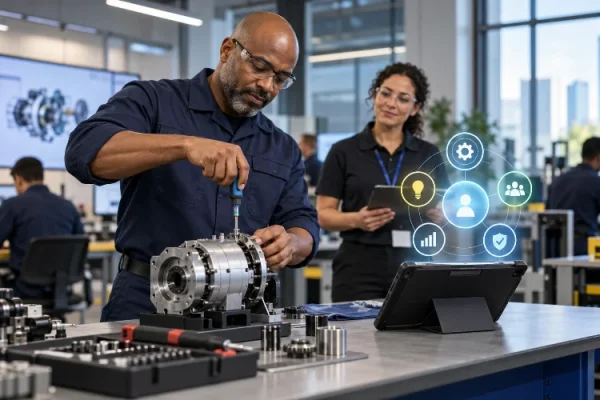
Imagine two employees joining the same professional development program. One already understands data analytics but struggles with communication skills, while the other communicates brilliantly but has never worked with data visualization tools.
Should they follow exactly the same training program?
Probably not.
Yet that’s precisely how many traditional learning systems still operate. Everyone receives identical content, follows the same sequence, and completes similar assessments regardless of their existing knowledge or career goals.
This one-size-fits-all approach becomes increasingly problematic as workplace skills evolve.
Personalized learning algorithms for dynamic skill development offer a different solution. Instead of treating learning pathways as fixed routes, these intelligent systems analyze learner performance, identify knowledge gaps, and recommend relevant educational experiences.
The result is a more flexible approach where training can evolve alongside individual progress.
And this isn’t just about making courses more convenient. It’s about helping organizations develop the right capabilities while giving learners greater control over their professional growth.
So, how do these algorithms actually work, and what does it take to build a learning system that adapts intelligently?
Let’s explore.
Why Traditional Learning Models Struggle With Changing Skill Requirements
Professional development used to follow a fairly predictable structure.
Organizations identified required competencies, created training programs, and assigned employees to relevant courses. Once those courses were completed, learners often received certificates and moved on.
Unfortunately, modern skill development isn’t quite that straightforward.
Skills Are Changing Faster Than Static Curricula
Technology, automation, and evolving business requirements continuously reshape what employees need to know.
According to the World Economic Forum’s Future of Jobs Report 2025, employers expect approximately 39% of workers’ existing core skills to change by 2030.
That projection highlights why organizations cannot depend entirely on training programs that remain unchanged for years.
Consider a marketing professional who learned traditional campaign management several years ago.
Today, their role might involve marketing automation, data interpretation, AI-assisted content creation, and increasingly sophisticated customer analytics.
Their development needs have changed, even if their job title hasn’t.
Static training catalogs frequently struggle to reflect these shifting requirements quickly enough.
Why Individual Learning Differences Matter
Two learners can complete the same course and develop very different levels of understanding.
One might master a concept immediately, while another needs additional practice or a different explanation.
Traditional learning systems often measure these outcomes through a final assessment.
Adaptive learning platforms can take a more detailed approach by examining patterns throughout the learning journey.
For example, repeated mistakes in spreadsheet formulas might indicate a specific knowledge gap rather than a general lack of analytical ability.
Recognizing that difference allows a system to recommend targeted practice instead of forcing someone to repeat an entire course.
This is where algorithm-driven personalization starts becoming genuinely useful.
How Personalized Learning Algorithms Actually Work
At their core, personalized learning algorithms use information about learners to make decisions about educational content, difficulty, timing, and progression.
Different algorithms solve different problems, so there isn’t one magical model that handles everything.
A practical adaptive learning system often combines several approaches.
Recommendation Algorithms
Recommendation engines help determine which learning resources are most relevant to a particular person.
Content-based filtering compares learner needs with characteristics of available materials, such as topics, difficulty levels, prerequisites, and targeted skills.
Collaborative filtering takes another approach by identifying patterns among learners with similar interests or learning histories.
Imagine several employees with comparable technical backgrounds successfully progressing from introductory Python courses into data analysis projects.
A recommendation engine might suggest a similar pathway to another employee with a matching profile.
However, these recommendations should consider actual competency requirements rather than relying entirely on popularity.
A frequently completed course isn’t necessarily the most educationally valuable option.
Knowledge Tracing Models
Knowledge tracing attempts to estimate how a learner’s understanding changes over time.
Bayesian Knowledge Tracing uses probabilistic assumptions about learning and performance to estimate whether someone has mastered a particular concept.
Deep Knowledge Tracing extends this idea using neural networks to model patterns across sequences of learner interactions.
Research by Chris Piech and colleagues demonstrated how recurrent neural networks could be used to predict student performance from learning histories.
For example, an adaptive mathematics platform might estimate a learner’s understanding of fractions based on their responses to several related questions.
The system could then select a more advanced exercise or provide additional foundational practice.
These estimates remain predictions, not direct measurements of knowledge.
A correct answer might result from guessing, while an incorrect response could reflect misunderstanding, distraction, or an unclear question.
Reinforcement Learning and Adaptive Decisions
Reinforcement learning explores how a system can improve decisions based on feedback from previous actions.
In education, this could involve selecting learning activities that are expected to improve future performance.
For instance, an algorithm might compare whether additional practice, a short explanation, or a practical simulation produces stronger subsequent results.
However, reinforcement learning requires carefully designed objectives and responsible experimentation.
Optimizing only for engagement could encourage easy activities rather than meaningful skill development.
That’s why sophisticated algorithms still need sound educational principles behind their decisions.
Mapping Skills and Building Meaningful Learner Profiles
Personalization becomes much more effective when organizations understand which skills their learners possess and which capabilities they need to develop.
That requires more than collecting course completion records.
Creating a Structured Skills Framework
A skills framework defines the competencies associated with particular roles, responsibilities, or professional goals.
For example, a data analyst might require statistical reasoning, spreadsheet proficiency, SQL knowledge, data visualization, and communication abilities.
Each competency can be broken down into smaller, measurable learning objectives.
A beginner might need to understand basic database queries, while an advanced analyst might need to optimize complex SQL operations.
The 1EdTech Competencies and Academic Standards Exchange (CASE) standard provides a structured approach to representing and exchanging competency information across compatible educational systems.
This kind of interoperability helps connect learning resources and assessments with recognized skill definitions.
Without consistent skill labels, different platforms may describe essentially identical competencies using incompatible terminology.
Developing Dynamic Learner Profiles
A learner profile combines relevant information about someone’s knowledge, experience, goals, and educational progress.
It might include demonstrated competencies, assessment outcomes, selected interests, completed projects, and preferred learning formats.
For instance, an employee may demonstrate strong project management abilities but limited experience with financial forecasting.
Rather than recommending generic business training, the system could prioritize financial modeling and budgeting exercises.
Profiles should update when meaningful new evidence becomes available.
Completing a practical assignment might increase confidence in a particular competency, while repeated difficulties could indicate a need for additional practice.
Importantly, profiles should not become permanent labels.
Someone who struggles with a topic today may develop strong proficiency after receiving appropriate support.
Designing Dynamic Learning Pathways That Adapt in Real Time
Once an organization understands its learning objectives and available learner information, it can start designing adaptive pathways.
Unlike traditional course sequences, these pathways can change when performance, skill requirements, or personal goals change.
Using Assessments to Guide Progression
Diagnostic assessments provide an initial understanding of a learner’s capabilities.
Imagine a cybersecurity training program covering network fundamentals, threat detection, incident response, and security compliance.
An experienced IT professional might demonstrate sufficient knowledge of network fundamentals to move directly into threat detection.
A newcomer could receive a foundational introduction before attempting more advanced material.
As both learners progress, short assessments can provide additional evidence about their understanding.
The platform can then adjust upcoming content based on demonstrated performance.
This doesn’t mean every mistake should trigger an entirely different pathway.
Effective systems distinguish between occasional errors and patterns that suggest a genuine learning gap.
Finding the Right Level of Challenge
Adaptive learning aims to provide activities that are appropriately challenging.
If material is consistently too easy, learners may disengage or spend unnecessary time reviewing familiar information.
If it’s too difficult, they may become frustrated or develop misunderstandings.
One practical method involves matching estimated skill proficiency with the difficulty of available activities.
For example, a learner who performs confidently on intermediate coding exercises might receive a more demanding debugging assignment.
Someone struggling with the same material could receive a worked example followed by guided practice.
The objective is steady development, not simply pushing everyone toward harder content as quickly as possible.
Applying Spaced Repetition
Not every learning challenge involves understanding something for the first time.
Remembering information over longer periods is equally important.
Spaced repetition algorithms schedule review activities at different intervals to support retention.
A major research review by Cepeda and colleagues examined 839 assessments from 317 experiments involving distributed practice.
Their findings showed that the spacing between study sessions and the intended retention period both influence later recall.
An adaptive language-learning application might therefore schedule additional practice for vocabulary that a learner repeatedly forgets.
The same principle can support technical terminology, compliance procedures, and professional certification preparation.
The best review schedule depends on the material, learner, and intended learning outcome.
Building the Data Infrastructure Behind Adaptive Learning
Intelligent personalization depends on reliable information flowing between different components of a learning platform.
Even sophisticated algorithms struggle when the underlying data is incomplete, inconsistent, or poorly organized.
Connecting Learning Systems and Data Sources
Organizations often store learning information across multiple applications.
An LMS manages courses, an HR platform maintains job information, assessment tools record performance, and skills management systems track competencies.
An adaptive learning platform needs appropriate access to the information required for its decisions.
APIs, structured event records, and common learner identifiers can help connect these systems.
For example, when someone completes a technical assessment, the result could update their competency profile and influence subsequent course recomendations.
However, every integration should have clear rules covering data ownership, accuracy, and access permissions.
Duplicating conflicting versions of learner records can quickly undermine personalization.
Turning Raw Activity Into Useful Insights
Learning platforms may collect substantial amounts of interaction data.
But watching a video for fifteen minutes doesn’t necessarily mean someone understood the content.
Likewise, completing an activity quickly doesn’t always indicate mastery.
Meaningful analytics should combine appropriate measures, including assessment performance, practical demonstrations, and evidence of longer-term skill retention.
Organizations should also distinguish between engagement metrics and actual learning outcomes.
A system that encourages learners to click through more content isn’t automatically improving their capabilities.
Useful personalization focuses on evidence of development rather than activity volume alone.
Maintaining Reliable Algorithm Performance
Models can become less useful when course catalogs, learner populations, or workplace requirements change.
A recommendation engine trained on last year’s training preferences might struggle with newly introduced competencies.
Regular evaluations help identify deteriorating prediction accuracy or irrelevant recommendations.
Teams also need processes for reviewing unusual results, correcting inaccurate skill profiles, and testing updated models.
Strong data governance makes this enviroment easier to manage over time.
Keeping Personalized Learning Fair, Transparent, and Human-Centered
Algorithmic decision-making creates opportunities, but it also introduces responsibilities.
Learning recommendations can influence professional development, access to opportunities, and perceptions of individual capability.
Those consequences deserve careful consideration.
Preventing Algorithmic Bias
Algorithms learn from available data, and that data may reflect historical inequalities or incomplete opportunities.
For example, employees who previously received more specialized training might appear more capable simply because they had greater access to relevant experiences.
A poorly designed recommendation engine could reinforce that difference by continuing to offer advanced opportunities to the same group.
Organizations should evaluate whether learning recommendations are equitable across relevant populations.
The NIST Artificial Intelligence Risk Management Framework emphasizes trustworthy AI characteristics such as reliability, transparency, privacy, and fairness.
These principles provide useful guidance when designing educational recommendation systems.
Protecting Learner Privacy
Personalized learning doesn’t require collecting every possible detail about an individual.
Organizations should prioritize relevant information, communicate how it will be used, and establish appropriate retention periods.
Sensitive learner records need secure storage, controlled access, and clear governance.
UNESCO’s guidance on generative AI in education emphasizes human-centered implementation, privacy protection, and responsible educational design.
Although not every adaptive learning system uses generative AI, these concerns remain relevant across educational AI applications.
Learners should have meaningful opportunities to understand and challenge important automated decisions.
Preserving Human Judgment
Algorithms are useful for identifying patterns, but they cannot fully understand every learner’s circumstances.
A sudden decline in assessment performance might reflect personal difficulties, unclear instruction, or unfamiliar technology.
An automated system may recognize the pattern without understanding its cause.
Teachers, mentors, and training managers provide essential context.
A well-designed platform allows educators to review recommendations, override unsuitable decisions, and provide additional support when necessary.
Personalization works best when technology strengthens human decision-making rather than replacing it.
Implementing and Measuring Personalized Skill Development
Building an adaptive learning ecosystem doesn’t require launching an enormous AI project immediately.
A focused, incremental implementation often provides a clearer understanding of what actually works.
Starting With a Defined Learning Problem
Begin by identifying a development challenge.
Perhaps employees spend too much time completing training they already understand, or learners repeatedly fail particular certification topics.
Choose measurable objectives before selecting algorithms.
A company might initially introduce diagnostic assessments and rule-based course recommendations for one technical department.
Once the approach proves useful, the organization can experiment with knowledge tracing or more sophisticated recommendation models.
This staged process makes implementation easier to manage and evaluate.
Measuring Real Skill Improvement
Course completions and platform engagement provide useful operational information, but they shouldn’t be the only success indicators.
Organizations should examine demonstrated competency improvement, assessment performance, retention, and practical workplace application.
For example, a customer support team might evaluate whether personalized training improves employees’ ability to resolve realistic service scenarios.
A software development team could measure progress through practical coding assessments.
Where feasible, controlled comparisons can help determine whether adaptive learning improves outcomes compared with conventional training.
Teams should compare similar learners, use meaningful assessments, and account for differences in previous experience.
Higher engagement alone isn’t proof that an algorithm produces better learning.
Improving the System Through Feedback
Learners should be able to indicate whether recommended material feels relevant, repetitive, or unnecessarily difficult.
Educators can also identify incorrect recommendations and content that doesn’t match intended competencies.
This feedback supports ongoing model evaluation and instructional improvements.
Imagine an organization discovering that employees consistently reject a recommended course because it covers an outdated software version.
The problem may involve the content catalog rather than the recommendation algorithm itself.
Addressing both technical and educational issues prevents unnecessary complexity.
Continuous maintainance matters because learning environments never remain completely static.
Preparing for Long-Term Skill Agility
The greatest opportunity is creating learning systems that adapt as professional requirements evolve.
Instead of rebuilding entire training programs whenever new technologies appear, organizations can update competency frameworks and introduce relevant learning resources.
The platform can then identify which employees may benefit from those new capabilities.
For example, a financial services company introducing AI-assisted analysis could map the required competencies against existing employee profiles.
Some workers might need foundational AI literacy, while others require advanced model evaluation or data governance training.
This approach makes professional development more targeted and responsive.
It also helps employees understand how individual learning activities connect to broader career opportunities.
Ultimately, the objective isn’t to predict every future skill requirement perfectly.
It’s to build a learning infrastructure capable of responding intelligently when those requirements change.
Personalized learning algorithms are changing how organizations approach professional development by making training more responsive to individual needs and evolving skill requirements.
Through recommendation engines, knowledge tracing, adaptive assessments, and competency mapping, learning platforms can deliver more relevant educational experiences.
However, successful personalization requires more than advanced machine learning models. Reliable data, meaningful assessment strategies, transparent recommendations, and human oversight are equally important.
Organizations should begin with clearly defined learning challenges and expand their capabilities as measurable evidence supports further investment.
The goal is not simply smarter technology, but better opportunities for people to develop valuable skills throughout their careers.
Ready to transform your learning strategy? Start by identifying your organization’s most important skill gaps, reviewing your learning data, and exploring how adaptive technologies can support more flexible, measurable, and meaningful development.